If you’re mid-30s or over, you may have noticed some subtle changes to your eyes in recent years. For instance, your upper lids may feel heavier than they used to, your makeup make settle into creases you never used to have, and you may have eye bags that linger, no matter how well you sleep.
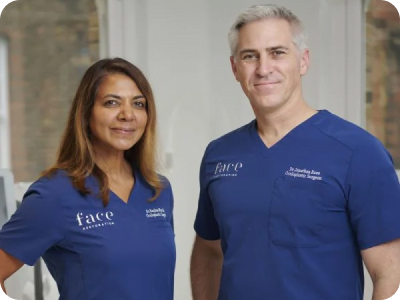
Dr Rachna Murthy and Professor Jonathan Roos specialise in blepharoplasty, which is designed to treat hooded lids, under-eye bags and other age‑related changes around the eyes. Keep reading for everything you need to know about blepharoplasty, which is one of the most commonly performed procedures here at Face Restoration.
What is blepharoplasty (eyelid surgery)?
A simple definition in everyday language
Also referred to as ‘eyelid surgery’, blepharoplasty is a procedure that involves removing excess skin over the eyes and/or repositioning fat or muscle. The benefits are widespread and include improved vision, eyelid functionality and overall eye health. It also helps enhance your aesthetic appearance by restoring and rejuvenating your facial contours and creating a more youthful appearance.
“Many people think blepharoplasty is just about cutting away skin. In reality the eyelids are a delicate, working part of the eye, so we plan every millimetre around how your eyes open, close and stay comfortable,” says Dr Murthy.
“Another common worry is that surgery will change how you look. Done well, it shouldn’t. It should bring back the eyes you recognise. Patients also don’t always realise that a heavy brow, dry eyes or eyelid muscle weakness can look like excess skin. That’s why a thorough assessment matters more than anything else.”
How it helps with hooded eyes and eye bags
Upper blepharoplasty targets the heavy, hooded upper eyelids, while lower blepharoplasty focuses on eye bags and loose skin beneath the eyes.
Problems blepharoplasty can treat
Hooded eyes and heavy upper eyelids
Upper eyelid blepharoplasty is used to address:
- Dermatochalasis – excess upper‑lid skin that folds over the lash line
- Hooded eyes – where skin drapes over the natural crease
- Droopy lids
- Ptosis – true muscle‑related drooping
- Tired‑looking eyes
- A‑frame deformity – where volume loss creates a hollowed upper‑lid contour
Eye bags, dark circles and puffy lower lids
Meanwhile, lower eyelid blepharoplasty is used to improve:
- Eye bags/eyelid bags
- Loose folds of skin
- Dermatochalasis of the lower lid
- Dark under-eye circles caused by shadows
- Tear trough hollowing
- Puffiness from fat prolapse
When eyelid surgery may help vision
In some cases, significantly droopy upper lids or excess skin can reduce peripheral vision. Upper blepharoplasty may improve this by lifting the skin away that is impacting the visual field.
Upper vs lower eyelid blepharoplasty
Upper eyelid blepharoplasty (hooded eyes)
Upper eyelid blepharoplasty restores the natural crease and removes unwanted soft tissues, creating a more youthful appearance for people with:
- Heavy or hooded lids
- Skin resting on the lashes
- Makeup sitting on folds
- A tired or closed‑off appearance
Lower eyelid blepharoplasty (eye bags)
Lower blepharoplasty smooths the lower lid contour and reduces heaviness beneath the eyes and is most suited for people with:
- Prominent eye bags
- Loose folds of skin
- Under‑eye puffiness
- Shadows or dark circles
Combined upper and lower blepharoplasty
Some patients, who have global eyelid ageing, i.e. hooded eyes and eye bags, can potentially benefit from both procedures, particularly if they want to rejuvenate their overall eye area.
Here at Face Restoration, upper eyelid blepharoplasty typically takes 35 minutes to carry out and involves 2 to 3 days’ initial recovery time. Meanwhile, lower eyelid blepharoplasty is a 60 to 90-minute procedure that requires 7 to 10 days’ initial recovery time.
What to expect before, during and after surgery
Consultation and personalised plan
Our consultations are carried out by Dr Rachna Murthy and Professor Jonathan Roos, both highly trained and experienced ophthalmic and oculoplastic surgeons, with Cambridge, Harvard and Moorfields backgrounds.
Together, they conduct a comprehensive pre‑operative evaluation, which involves examining the eyelid position, skin quality, fat distribution and eye health, as well as incorporating patients’ personal goals. Using detailed imaging and precise measurements, they create a personalised surgical plan that protects eyelid function, enhances facial harmony and supports a refreshed and natural-looking end result.
How blepharoplasty is done
Blepharoplasty is a precise, carefully sequenced procedure designed to refresh the eyelids while keeping the results natural.
For upper eyelid surgery: A fine incision is placed within the eye’s natural crease. This allows excess skin to be removed and any fat or muscle to be gently repositioned. Once the contour is refined, the incision is closed with ultra‑fine sutures that sit discreetly within the fold, making them barely visible once healed.
For lower eyelid surgery: The approach depends on your anatomy. Most patients benefit from a transconjunctival incision, made inside the lower lid, which allows fat to be repositioned or reduced without leaving an external scar. If skin tightening is also needed, a delicate incision may be placed just beneath the lash line, enabling loose skin to be smoothed and refined.
In both cases, adjustments to fat, skin and muscle are made with the utmost care to create a smooth, balanced under‑eye contour and refreshed, natural appearance.
Recovery, results and longevity
Recovery is often far more straightforward than patients expect. Swelling and bruising tends to settle within one to two weeks with Face Restoration’s clinically proven Purifeyes™ spray and Microbial Mantle™ aftercare skincare protocol. Most people:
- Return to work within 7 to 10 days
- Apply makeup after 10 to 14 days
- Start exercising again around 3 to 4 weeks
The results continue to refine as the under‑eye contour smooths, hollowing softens and the transition from eyelid to cheek becomes more harmonious. Patients frequently describe their eyes as brighter, less fatigued and more naturally refreshed – a transformation that lifts the entire face. Furthermore, excess upper eyelid skin removal typically maintains its appearance for more than ten years.
Dr Murthy explains: “When we remove excess upper eyelid skin, that skin doesn’t grow back. That’s why the result of a well-planned upper blepharoplasty often lasts 10 years or more, and for many patients much longer.
“Your face will keep ageing naturally, so the brow may slowly settle, and the skin may lose a little elasticity over time. But you start from a fresher, more open baseline, and most people still look better than they would have without surgery many years later. How long it lasts depends on careful planning, your skin quality, your brow position and how you look after your skin and eyes afterwards.”
Blepharoplasty vs non‑surgical treatments
Creams, fillers and other treatments
For mild hooding or early eye bags, non‑surgical options may help. They include:
- Injectables to soften wrinkles or subtly lift the brow
- Skin resurfacing to improve texture
- Advanced skincare for hydration and firmness
- Plasma treatments for light skin tightening
These treatments tend to be used when changes are early or subtle.
When surgery is the more effective choice
When excess skin is significant or eye bags are pronounced, surgery is usually the most effective long‑term solution. Creams and fillers cannot remove excess tissue or correct deeper anatomical changes.
Professor Roos explains: “When the problem is excess skin, creams, injectables and devices can only do so much. Surgery deals with the cause directly. It’s a single, precise procedure that can be done under local anaesthetic, and it gives a long-lasting result that non-surgical treatments can’t match.
“For the right patient, assessed properly and treated by an experienced oculoplastic team, it’s one of the most reliable and rewarding procedures we offer.”
Revision blepharoplasty and second opinions
When revision eyelid surgery is considered
Revision blepharoplasty may be needed when:
- Asymmetry persists
- Eye bags remain
- Lid retraction occurs
- Scarring affects eyelid position
- Previous surgery did not achieve the desired result
These issues are common reasons patients seek a second opinion.
How specialist revision helps
In most cases, patients undergo lower and upper eyelid blepharoplasty revision surgery because they are unhappy with the results of their previous eyelid surgery elsewhere. Dr Rachna Murthy and Professor Jonathan Roos are award-winning oculoplastic surgeons, who have the specialist expertise and experience to perform this complex, delicate surgery.
Dr Murthy explains: “Revision surgery is a different challenge from first-time surgery. Some tissue may already be missing, there can be scarring, and the eyelid may not close or sit as it should.
“Before we suggest anything, we need to understand exactly what was done before, how your eyelids are working now and how healthy the surface of your eye is. Sometimes the answer is careful surgery, sometimes it’s another approach, and sometimes the best advice is to wait. A detailed specialist assessment keeps your eye health and comfort at the centre of every decision.”
Feedback from one of our revision surgery patients:
“I had surgery with Dr Rachna Murthy and Dr Jonathan Roos back in August 2021, and I’m now returning five years later for further eye surgery. I cannot recommend them both highly enough. I carried out extensive research before choosing my surgeons and found them to be among the leading oculoplastic surgeons in the UK.
“Their professionalism, expertise and outstanding reputations gave me complete confidence in my decision. Their aftercare is also first-class, and it’s clear that they genuinely care about their patients, taking the time to ensure you feel supported and well looked after throughout the process.
“Having had such a positive experience previously, I wouldn’t hesitate to recommend Dr Rachna Murthy and Dr Jonathan Roos to anyone considering oculoplastic surgery. I’m looking forward to seeing them both again!”
Choosing the best cosmetic eye surgeon
Why choose an ophthalmic/oculoplastic surgeon for eyelid surgery
Choosing an ophthalmic/oculoplastic surgeon means your eyelid surgery is carried out by a doctor whose entire training is centred on eyelids, periocular structures and eye health.
Oculoplastic surgeons complete full ophthalmology training before subspecialising, giving them a level of anatomical and functional expertise that general cosmetic surgeons simply do not have. Following Moorfields‑style guidance, they prioritise safety, eyelid function and long‑term ocular comfort.
When comparing surgeons, focus on ophthalmic qualifications, recognised oculoplastic fellowships and eyelid‑specific surgical experience.
About Dr Rachna Murthy and Professor Jonathan Roos
Here at Face Restoration, our award-winning dual consultant team, Dr Rachna Murthy and Professor Jonathan Roos, bring Cambridge, Harvard and Moorfields‑trained expertise to every case. Their work blends medical precision with aesthetic judgement, ensuring cosmetic improvements never compromise eye health – the crucial benefit of entrusting your eyelid surgery to a highly trained oculoplastic surgeon.
“I was absolutely delighted with the results of my upper blepharoplasty, and actually, the whole process. The procedure went exactly as Jonathan and Rachna explained it would; they’re so proficient at what they do, and so reassuring.
“It’s probably the single thing that I could do that’s made the biggest impact on my appearance and therefore on my confidence, just to not feel that I’m looking tired all the time. I can actually see the shape of my eyes, see my eyelids, which I wasn’t able to before – that’s really wonderful. Absolutely, it’s worth it if that’s an area that you’re worried about.” – Beth
Face Restoration locations
Face Restoration offers specialist eyelid and periocular surgery across several leading clinical settings, giving patients convenient access to our pioneering dual‑surgeon expertise. You can see us at:
- Belgravia, London
- Harley Street, London
- One Welbeck, London
- Coach House Clinic, Trumpington
- Maison Restorative, St Helier, Jersey
- Caymen Islands
Is blepharoplasty right for you?
The simple self‑check
If you recognise any of the following, you may want to consider blepharoplasty:
- Hooded lids that make your eyes look heavy or tired
- Under‑eye bags or puffiness that persist even with good sleep
- Makeup sitting on folds or smudging due to excess upper eyelid skin
- Partially obscured vision, especially peripheral vision
- Eyes that feel strained, heavy or less open than they used to
- Dark circles or hollowing beneath the eyes
- Previous eyelid surgery that left asymmetry, scarring or contour irregularities
- Discomfort, dryness or irritation linked to eyelid position
- A desire for a natural, refreshed appearance
What happens in a Face Restoration consultation
Our consultations are designed to be calm, clear and genuinely helpful – a hallmark of the Face Restoration experience.
We begin by discussing your goals, concerns and any symptoms, such as heaviness, puffiness or visual obstruction. A dual‑clinician assessment follows, where both surgeons evaluate eyelid position, skin quality, tear film, muscle function and overall facial balance. High resolution imaging and precise measurements help us plan the safest, most natural‑looking approach.
“A natural result means people notice you look rested and well, but they can’t tell you’ve had surgery. In practice that means taking out the right amount of skin and no more, keeping the natural eyelid crease and fullness, respecting the shape of your eyes and making sure your eyes close comfortably,” says Professor Roos.
“Taking too much is far harder to fix than taking too little. That’s why we both mark and cross-check every case, and we treat precision and restraint as the priority.”
Throughout, we explain the procedure, risks, alternatives and expected outcomes in plain language, giving you plenty of time to ask questions. You’ll leave with a personalised treatment plan and a clear understanding of what to expect before, during and after surgery.
“From my consultation through to the post-op care, I could not have possibly expected the care and consideration I received from Dr Murthy and Professor Roos. I had been considering upper blepharoplasty for some time, and although this was something I wanted to do, I was still apprehensive before my consultation and again a few days before my op. Both doctors spent just over an hour with me at my consultation, talking me through what to expect and all the details of the operation. I also received a very informative pack outlining all the preparation and post op care….” – feedback from one of upper blepharoplasty patients.
Blepharoplasty FAQs
(for hooded eyes and eye bags)
Is eyelid surgery (blepharoplasty) only cosmetic, or can it help my vision?
Blepharoplasty can be both cosmetic and functional. When excess upper eyelid skin obstructs peripheral vision, removing it can widen your field of sight and reduce eye strain. Many patients notice clearer vision for reading, driving and everyday activities. It can also improve overall comfort by restoring natural eyelid position and movement.
What’s the difference between hooded eyes and eye bags, and can blepharoplasty treat both?
Hooded eyes occur when excess upper eyelid skin folds over the lid, making the eyes look heavy or tired. Eye bags relate to puffiness or bulging beneath the eyes caused by fat prolapse or skin laxity. Blepharoplasty can address both – upper blepharoplasty lifts and defines the upper lid, while lower blepharoplasty smooths puffiness and restores the under-eye contour.
Will my eyes look ‘natural’ after blepharoplasty?
Yes, natural results are central to our dual‑surgeon approach. We refine eyelid contours, reposition fat where needed and avoid over‑resection, ensuring patients’ eyes look refreshed rather than altered. Our minimally invasive technique under local anaesthetic allows us to assess symmetry throughout, achieving balanced and authentic results.
How long does recovery take and when can I go back to work after blepharoplasty?
Recovery is typically faster than most patients expect. Upper blepharoplasty patients often return to work within 2 to 3 days, while lower blepharoplasty usually requires 7 to 10 days. Swelling and bruising settle quickly with our Scarless™, Microbiome Mantle™ and Purifeyes™ protocols. Final refinement continues over the following weeks.
Can you help if I’m unhappy with previous eyelid surgery?
Yes, revision blepharoplasty is one of our specialist areas. We can address asymmetry, residual hooding, scarring, contour irregularities, hollowing or functional issues caused by previous surgery. Using advanced imaging and dual‑surgeon planning, we restore natural contours and improve comfort, confidence and natural-looking facial harmony.
How do I choose the right cosmetic eye surgeon?
Look for an oculoplastic surgeon with extensive eyelid‑specific experience, strong qualifications and a track record of natural results. Uniquely, our dual‑surgeon team offers additional precision and safety.
Blepharoplasty can be both cosmetic and functional. When excess upper eyelid skin obstructs peripheral vision, removing it can widen your field of sight and reduce eye strain. Many patients notice clearer vision for reading, driving and everyday activities. It can also improve overall comfort by restoring natural eyelid position and movement.
Book a blepharoplasty consultation
For hooded eyes and heavy lids
For eye bags, puffiness or loose lower-lid skin
For concerns about previous eyelid surgery
- Learn more about upper eyelid blepharoplasty revision and second opinions
- Learn more about lower eyelid blepharoplasty revision and second opinions
- Contact us for a second opinion
Not sure which procedure is best for you?